Total Pageviews

3/3/13

Lava Lake At The Nyiragongo Volcano


Mount Nyiragongo is located inside Virunga National Park, in the Democratic Republic of the Congo, about 20 km north of the town of Goma and Lake Kivu. It is one of the most active volcanoes in Africa, and one of eight volcanoes in the Virunga Mountains. The main crater is about two km wide and usually contains a lava lake which appear in the summit crater.

Nyiragongo's lava lake has at times been the most voluminous known lava lake in recent history. The depth of the lava lake varies considerably depending on the activity of the volcano. A maximum elevation of the lava lake was recorded at about 3250 m (10,700 ft) prior to the January 1977 eruption - a lake depth of about 600 m (2000 ft). A recent very low elevation of the lava lake was recorded at about 2700 m (8800 ft).

Not much is known about how long the volcano has been erupting, but since 1882, it has erupted at least 34 times, including many periods where activity was continuous for years at a time, often in the form of a churning lava lake in the crater.

Lava Lake At The Nyiragongo Volcano

The lava emitted in eruptions at Nyiragongo is often unusually fluid, possibly due to the presence of melilite nephelinite, an alkali-rich type of volcanic rock having unusual chemical composition. Because of the extreme fluidity, Nyiragongo's lava flows can race downhill at up to 60 miles per hour (up to 100 km/h), whereas most lava flows at a walking pace and rarely pose a danger to human life.

Between 1894 and 1977 the crater contained an active lava lake. On 10 January 1977, the crater walls fractured, and the lava lake drained in less than an hour overwhelming villages and killing at least 70 people. Some reports quote much higher figures of up to several thousand people. The hazards posed by eruptions like this are unique to Nyiragongo. Nowhere else in the world does such a steep-sided stratovolcano contain a lake of such fluid lava.

Another major eruption of the volcano began on January 17, 2002. Lava from the reformed lava lake streamed out in 200 to 1000 m wide streams and up to 2 m deep. Warnings had been given and 400,000 people were evacuated from the city across the Rwandan border into neighbouring Gisenyi during the eruption. Despite the precautionary measures, about 147 people died in the eruption from asphyxiation by carbon dioxide and buildings collapsing due to the lava and earthquakes.

Six months after the start of the 2002 eruption, Nyiragongo volcano erupted again. Activity at Nyiragongo is ongoing, but currently confined to the crater, where another lava lake has formed about 250 metres below the level of the 1994 lava lake.

In June 2010, a team of scientists and intrepid explorers stepped onto the shore of the lava lake boiling in the depths of Nyiragongo Crater. These pictures are from the trip, by photographer Olivier Grunewald.

Lava Lake At The Nyiragongo Volcano


Re: Lava Lake At The Nyiragongo Volcano


Lava Lake At The Nyiragongo Volcano

Re: Lava Lake At The Nyiragongo Volcano


Lava Lake At The Nyiragongo Volcano

Re: Lava Lake At The Nyiragongo Volcano


Lava Lake At The Nyiragongo Volcano

Fanciest Kites in the Sky


Fanciest Kites in the Sky


Re: Fanciest Kites in the Sky


Fanciest Kites in the Sky

Re: Fanciest Kites in the Sky


Fanciest Kites in the Sky

Re: Fanciest Kites in the Sky


Fanciest Kites in the Sky

Most Amazing Ice Formations


This image is from behind the frozen Minnehaha Falls. Located in a Minneapolis park, Minnehaha Falls are near the point where the Mississippi River and Minnehaha Creek converge.

 
The famous Briksdal Glacier is a part of the Jostedalsbreen Glacier, the largest glacier on mainland Europe.

 
Frozen Plitvice Lakes, Croatia.

 
The incredible concentric forms you see above are neither crop circles nor alien landings -- they are part and parcel of the world's largest artwork, which spans nine square miles! Jim Denevan, who created the previous world's-largest-artwork in the Nevada desert, headed out to Siberia to draw these beautiful patterns on ice with a team of helpers and a broom. Denevan is known for creating expansive, meditative works with repetitive patterns and endless scale. Given that, Lake Baikal seems like the perfect canvas, since it's the world's largest lake. Even when the harsh Siberian winds carried the resulting artwork to the clouds, the momentary grace of the work is stunning.

 
Another amazing shot from the frozen lake Baikal in Siberia, Russia.
 
Lake Baikal is the the world.s oldest and deepest lake. Experts say that it is approximately 25 million years old (possibly older) and has an average depth of 744.4 meters (2,442 ft). A group of photographers documented their trip to Siberia where they crossed the lake on ice skates. Beautiful photography and even more beautiful nature! Baikal is also the largest fresh water source in the world, containing approximately 20% of the world's fresh water supply.

 
It's an amazing natural sight at Abraham Lake with the Frozen bubbles under the ice. The explanation of the rare phenomenon is, “The plants on the lake bed release methane gas and methane gets frozen once coming close enough to the much colder lake surface and they keep stacking up below once the weather gets colder and colder during [the] winter season.”


Winter time in Geneva, Switzerland.

 
With large icicles reaching from the ground to the sky, it was certainly different from the usual hedgerows you see in Norfolk. As a result, drivers and walkers alike stopped and admired the strange phenomena in Salhouse. Their gaze had been attracted to a hedge in Honeycombe Road that had been covered entirely in icicles


10 Most Captivating Deserts


10 Most Captivating Deserts

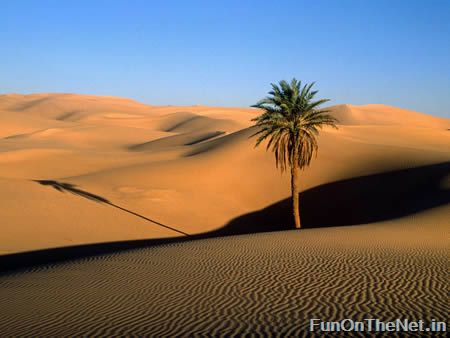
Here are 10 of the most Captivating and Bretahtaking Deserts!  From the Sahara, the worlds largest to the Farafra in Egypt and even the Taklamakan, a desert covered with snowfall!
 10 Most Captivating Deserts


Taklamakan (Central Asia): a desert covered with snowfall

Captivating Deserts

 
Taklamakan is one of the largest sandy deserts in the world, ranking 15th in size in a ranking of the world's largest non-polar deserts. It covers an area of 270,000 km2 (100,000 sq mi) of the Tarim Basin, 1,000 kilometres (620 mi) long and 400 kilometres (250 mi) wide. It is crossed at its northern and at its southern edges by two branches of the Silk Road as travelers sought to avoid the arid wasteland.

In 2008, China's biggest desert experienced its biggest snowfall and lowest temperature after 11 consecutive days of snow. Snow is rare in the desert that covered 337,600 square kilometers, never before had the whole desert been covered.

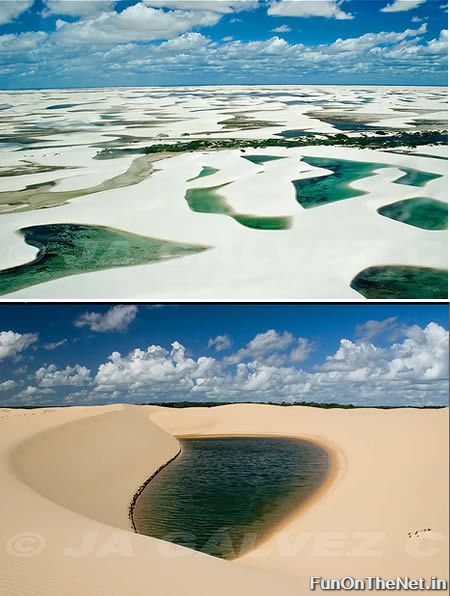
Lençóis Maranhenses (Brazil): a ‘desert' with lagoons

Captivating Deserts

 
It seems incredible, but in a country that keeps around 30% of the fresh water and shelters the largest rain forest in the world, we can find a “desert”. Located in the State of Maranhão, on the north shore of Brazil, the Lençóis Maranhenses National Park is an area of about 300 square kilometers (155,000 ha) of blinding white dunes and deep blue lagoons, forming one of the most beautiful and unique places in the world. The dunes invade the continent over 50km (31 miles) from the cost, creating a landscape that reminds a white bed sheet, when seen from above.

But you may ask: -Lagoons?? You told me it was a desert… Yes, what defers this region from a desert is the amount of rain that drops over the dunes, creating ponds of crystal clear water on the depression between dunes. Despite its desert-like appearance, Lençóis Maranhenses records an annual rainfall of 1,600mm (i.e. 62.9 inches), 300 times more than in the Sahara. During the period of drought, the lagoons evaporate and become completely dried. After the rainy season, the lagoons are home of many species of fish, turtles and clams. The mystery in this story lies in the fact that when the lagoons fill up, life comes back, as if they had never left the place. One of the hypotheses to explain the phenomenon is that the eggs of the fish and crabs are maintained alive in the sand, exploding when rain comes back.

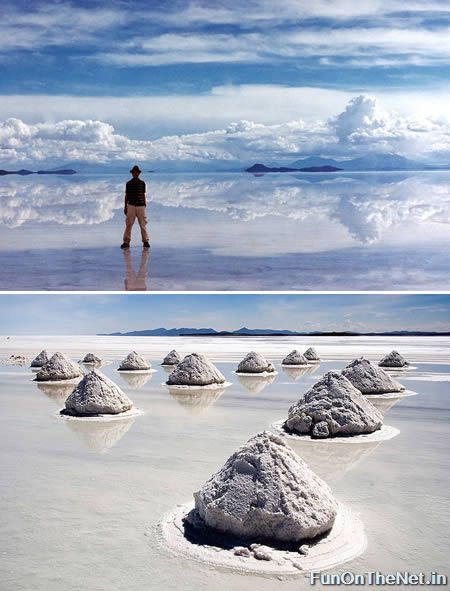
Salar de Uyuni (Bolivia): the world's largest salt desert

Captivating Deserts

 
The Salar is one of the iconic images of Bolivia, a massive salt desert in the middle of the Altiplano. It is an expansive, virtually flat desert that reflects the sun in such a way as to create a mirror effect with the sky. There are several lakes in the desert with strange colours from the mineral deposits in the region.

Some 40,000 years ago, the area was part of Lake Minchin, a giant prehistoric lake. When the lake dried, it left behind two modern lakes, Poopó Lake and Uru Uru Lake, and two major salt deserts, Salar de Coipasa and the larger Uyuni. Uyuni is roughly 25 times the size of the Bonneville Salt Flats in the United States. It is estimated to contain 10 billion tons of salt, from which less than 25,000 tons is extracted annually.


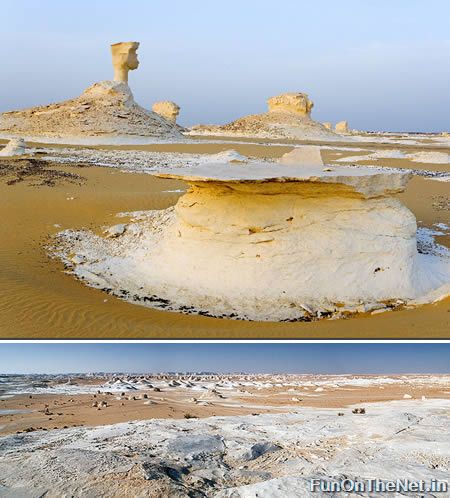
Farafra (Egypt): the white desert

Captivating Deserts

A main geographic attraction of Farafra is its White Desert (known as 'Sahara el Beyda,' with the word 'sahara' meaning a desert). The White Desert of Egypt is located 45 km (30 miles) north of Farafra. The desert has a white, cream color (it is truly white, in clear contrast with the yellow deserts elsewhere) and has massive chalk rock formations that have been created as a result of occasional sandstorms in the area.


Atacama (Chile): the flourished desert

Captivating Deserts

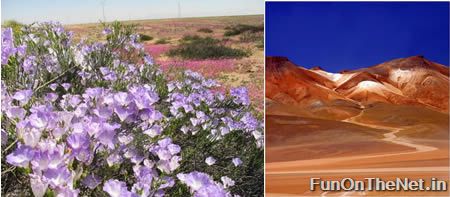
The Atacama Desert occupies the largest amount of the Chilean territory located north of the 29th parallel. The area located on the coast between Arica and Antofagasta appears in the Guinness Book of World Records as the driest place in the world. Nevertheless, to the south of the Tropic of Capricorn, the desert becomes kinder towards living beings. The coastal mists, "camanchacas", are more abundant south of Antofagasta and bring the humidity necessary for the maintenance of the coastal scenic vegetation. Many plants survive mainly because of the "camanchaca", and the harsh savings of water, in normal dry years, that causes them to delay important functions such as growth, to favor survival and reproduction. (Link)


Namib (Namibia): the only desert with elephants

Captivating Deserts

 
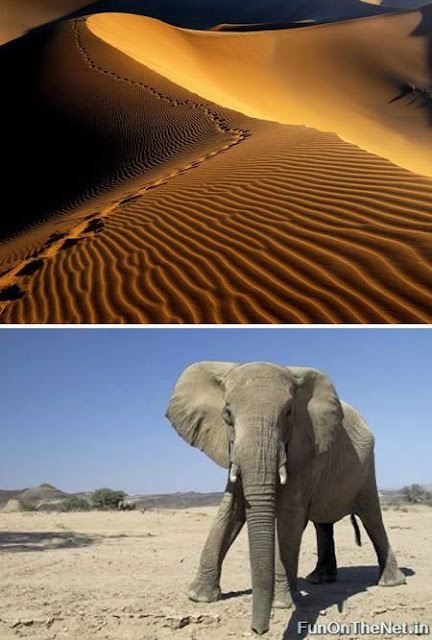
South of Africa lies the Namib desert. which is less vast than the Sahara but just as impressive. It forms part of the Namib-Naukluft National Park with neighbouring Angola. The Sossusvlei sand dunes are the highest in the world, some towering at 300m high and if you are lucky enough, you can stumble across desert elephants-the Namib is the only desert in the world to have elephants. Apparently the oldest desert in the world, myriad species of plants and animals can only be found here. The Namib has fascinated geologists for years but it remains very little understood to this day. Off the coast, strong southerly winds with fogs and strong currents cause sailors to lose their way; the north coast has been named 'Skeleton Coast' due to the amount of shipwrecks found there, some of which can be found as much as 50m inland, as the desert slowly takes over the ocean as it moves westwards.


Simpson Desert (Australia): the red sand desert

Captivating Deserts

 
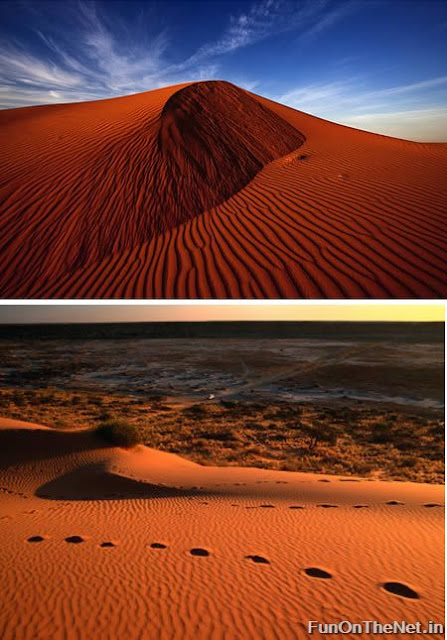
Australia is home to four large deserts, popularized by Mad Max: Sturt's Stoney Desert, Tanami Desert, the Great Victoria Desert and the Simpson Desert, which is also known as 'The Big Red' due to the presence of dunes of red sand. The Simpson Desert is an erg which contains the world's longest parallel sand dunes. These north-south oriented dunes are static, held in position by vegetation. They vary in height from 3 metres in the west to around 30 metres on the eastern side. The most famous dune, Nappanerica, or, more popularly, Big Red (named by Simpson Desert traveller Dennis Bartell), is 40 metres in height.


The Black Desert (Egypt): the desert with black stones
Captivating Deserts

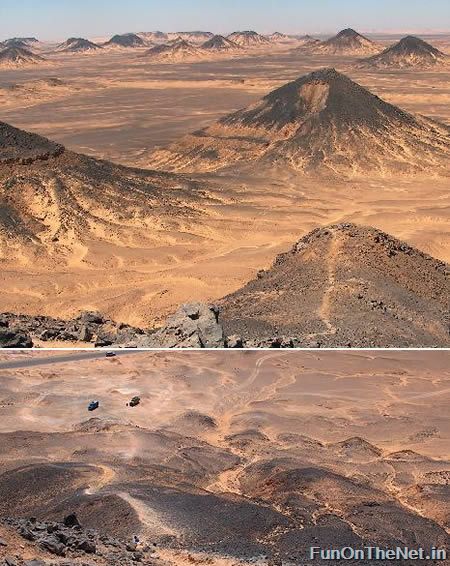
Located 100km northeast of the White desert, the Black Desert is a region of volcano-shaped mountains with large quantities of small black stones. The stones lie out across the orange-brown ground, so that it is not quite as black as many people may hope for. Especially after visiting the White Desert, which has formations that are really white, many will imagine a desert as dramatic as this. Climbing one of the many soft peeks, the view from the top is really nice, with similar peeks continuing on into the haze. The Black Desert is uninhabited. (Link)


Antarctica: world's driest and wettest desert

Captivating Deserts

 
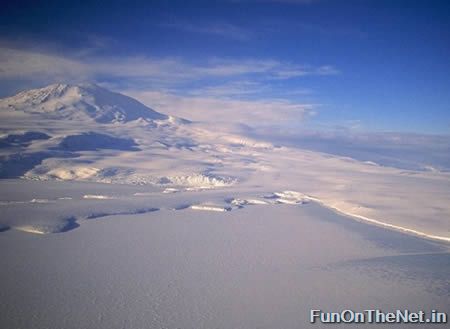
Antarctica is a land of extremes. It's not inhabited year round by humans because it's simply too freezing cold. In 1983 scientists recorded extreme cold temperatures as low as -129 Fahrenheit. It's also the wettest place on Earth, but simultaneously the driest. The reason it's the “wettest” is not because of rainfall; since Antarctica is covered by 98% ice, it's technically very wet. However since it's also the aforementioned coldest place in the world, it gets very little precipitation – less than 2 inches a year. Which makes Antarctica a desert. A brutally cold ice desert with a massive trench full of even more…ice. Three for the price of one!

Sahara (North Africa): world's largest desert

Captivating Deserts

 
The Sahara, with a size of 8.6 million km², is the world's largest desert, covering large parts of North Africa. Around 4 million people live there. Its maximum length is 4,800 km, running from west to east, and up to 1,200 km from north to south. Sahara covers most of Mauritania, Western Sahara, Algeria, Libya, Egypt, Sudan, Chad, Niger and Mali, and touches Morocco and Tunisia.

Sahara is very dry but there is an annual rainfall in most regions, although just a few dozen millimetres.

Tips to improve Fuel Economy


Tips to improve Fuel Economy

Here are some very good tips on improving your vehicle's Fuel Economy / Increase Fuel Efficiency / Mileage. With increasing fuel prices it is becoming more and more prudent to use them.
Use your gears wisely.
Driving in the highest gear possible without labouring the engine is a
fuel-efficient way of driving. A vehicle travelling at 60kmph in third gear
uses 25 percent more fuel than at the same speed in fifth gear

Drive smoothly
Think ahead! By applying light throttle and avoiding heavy braking, you can
reduce both fuel consumption and wear and tear. Try to predict traffic at
junctions and when in queuing to avoid accelerating and then braking.
Research suggests driving techniques can influence car fuel efficiency by as
much as 30 percent.

Switch off your engine
There are two schools of thought on this one. Switching your engine off for
short periods of time can actually increase fuel consumption, as it requires
more fuel to get the engine started. Also your catalytic converter will no
longer be running at full temperature and so your car will be less
efficient, increasing the amount of pollution you cause. However if you are
stopped for more than a few minutes then your car will simply burn less fuel
with the engine stopped.

Drive off promptly to prevent wasting fuel
Don't leave your engine running when you first start up. Drive off straight
away if you can, but drive gently until the engine has reached its normal
operating temperature. This doesn't increase fuel efficiency as such, but it
does mean your engine is switched on for less time.

{mosgoogle left}
Lighten your load
Think carefully about what you need on a journey. if you do not need
something, do not pack it. Remove roof racks if not needed. The lighter the
load, the lower the fuel consumption, and emissions, and the higher the fuel
efficiency.

Tyres effect fuel efficiency
It is estimated that about 50% of tyres on the road are under inflated.
Aside from increasing the rate of wear, this wastes fuel and decreased your
fuel efficiency. Check your tyre pressures every fortnight. Worn tyres will
also decrease fuel efficiency (and your safety!), so check the tread
regularly. If you are replacing tyres then consider some of the newer 'Eco'
tyres that are designed specifically to increase fuel efficiency.

Car Windows
Driving with your windows open drastically reduces your fuel efficiency, far
more so than putting the air conditioning on when motorway driving. So in
those hot summers(?) preferably keep the windows shut, and the air
conditioning on if you want to keep cool. Of course the air conditioning
decreases fuel efficiency too, so try not to over use it.

Invest in a new fuel efficient car
New cars come in all shapes and sizes, but it is possible to pick a new car
that can greatly reduce your fuel bill, and your fuel emissions.

Size matters. Choose an economical car - small cars use far more fuel
efficient and produce lower emissions than large cars.

Drive the most fuel-efficient car that meets your needs. Compare models and
classes. Even similarly sized cars can vary in fuel efficiency by up to 45%.

Consider diesel engines (with a particulate trap), and LPG (Liquefied
Petroleum Gas) and CNG (Compressed Natural Gas) fuelled cars - all have
lower CO2 emissions than standard petrol cars.

Consider 'hybrid' vehicles - they combine a conventional engine with an
electric motor and battery. These offer reduced fuel consumption and CO2
with potentially lower emissions of all pollutants.

Diesel Engines
If your going to buy a diesel, ensure it is a new 'common rail' type, as
these are approximately 10% more efficient than older diesels. also replace
(or clean if applicable) air cleaner elements as often as is required by
your vehicles servicing schedule.

Regluar Maintenance maintains fuel efficiency

Air Filter:
One of the most common reasons for a drop in fuel efficiency is a dirty
intake filter. This will decrease the amount of air entering the cylinders
of the engine resulting in incomplete combustion. Check the filter regularly
to ensure that it is clean.


Spark Plugs

Ensure your spark plugs are in good condition. Renew the plugs and wires at
intervals specified by the owners manual. This will keep all cylinders
firing properly resulting in higher efficiency.


{mosgoogle left}
Lube Oil:
Change the lube oil at intervals specified by the owners manual. Use the
recommended oil only especially in newer cars. Use of an engine flush before
changing the oil will help to get rid of a lot of the dirt that collects in
the engine that a normal oil change will not remove. On older engines it is
advisable to use an oil treatment agent. This basically thickens the oil
which creates a better seal between the piston and the liner, preventing
blow past and consequent loss of combustion pressure, resulting in higher
fuel efficiency.

Exhausts alter fuel efficiency
Most cars have special sizes for the exhaust. When cars are reasonably old
the silences has to be changed. The garage people always try to fit a size
that they have in the garage it self. Which might not be the exact size
recommended for the car. The wrong size a bigger or smaller silencer size
effects on the MPG of the car and the HP of the car. It may be cheaper to
put another size than your recommended size for your car but on the long run
it will cost you in many ways, especially on fuel consumption. Always put
the recommended size of the exhaust that is indicated in your car manual
because the car company knows how to optimize the performance of your car.
{mosaddphp:register.php}

3/2/13

Corporate Dressing for Women

Corporate Dressing for Women

Here are some useful Business Corporate Dressing tips for Women.  These days, when women are equally comfortable chairing boardroom meetings, corporate dressing has taken on a whole new meaning. Here are a few wardrobe musts.
1. Treat your business clothing as an investment and choose wisely. Make sure you buy classic styles that suit your body shape, are comfortable, have quality workmanship and quality material. This is no time to try the latest fads. Take your time and shop around for the best price and the best service. Be aware of the return policy and if possible purchase your wardrobe items at a store that can do professional alternations if necessary.

Corporate Dressing Women


2 . For business/corporate situations match your handbag , shoes and belt. Black shoes should be matched with a black handbag. This is not a time to get creative with your accessories or to wear colored shoes.

Corporate Dressing Women


3. Do not neglect your outerwear . Purchase a good quality coat that can be worn with either pants or a skirt. For cooler weather don't neglect your outdoor footwear. For skirts choose long knee-high boots.

Corporate Dressing Women


4. Keep shoes and boots in a good state of repair. Scuffed shoes with worn heels will ruin the look of your outfit.

Corporate Dressing Women


5. To complete your look choose soft leather gloves that will add a nice touch as well as keep your hands from getting chapped.

Corporate Dressing Women


6. Choose clothing material that reflects the season. Heavy fabrics and tweeds are best for Fall and Winter and will look out of place during Summer, as light linen fabrics will look out of place during Winter.

Corporate Dressing Women


7. Always wear a belt where there are belt loops . Choose a good quality leather belt and don't be tempted to wear a flashy or plastic belt. If you don't like belts choose pants without loops

Corporate Dressing Women

China to Launch Next Manned Space Mission in Summer

Date: 28 February 2013 Time: 03:18 PM ET

The mighty ''Gol Gumbaz''


Bookmark and Share

 The mighty ''Gol Gumbaz''

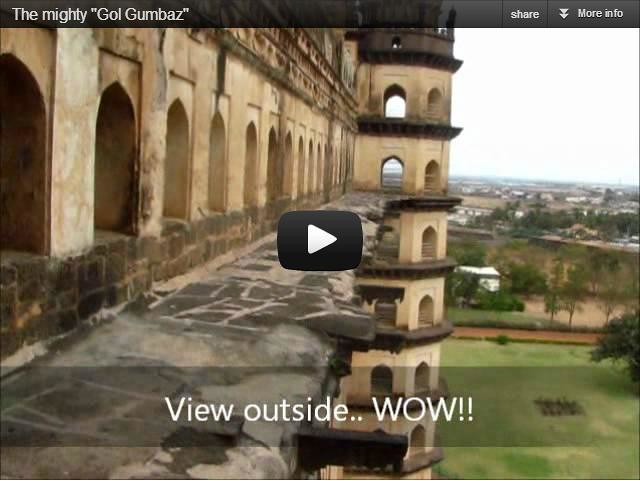
"Gol Gumbaz" in Bijapur is the largest dome in the world. The city is full of wonderful MUST SEE monuments..
http://www.nidokidos.org/threads/176013-The-mighty-Gol-Gumbaz ===================================================

2/27/13

Colosseum in Rome


Colosseum in Rome

Colosseum in Rome
The Colosseum or Coliseum, originally known as the Flavian Amphitheatre, is a giant amphitheatre in the centre of the city of Rome. Originally capable of seating 50,000 spectators, it was used for gladiatorial contests and public spectacles. It was built on a site just east of the Roman Forum, with construction starting between 70 and 72 AD under the emperor Vespasian. The amphitheatre, the largest ever built in the Roman Empire, was completed in 80 under Titus, with further modifications being made during Domitian's reign.

 
Colosseum in Rome
Colosseum in Rome
Colosseum in Rome
The Colosseum remained in use for nearly 500 years with the last recorded games being held there as late as the 6th century — well after the traditional date of the fall of Rome in 476. As well as the traditional gladiatorial games, many other public spectacles were held there, such as mock sea battles, animal hunts, executions and dramas based on Classical mythology. The building eventually ceased to be used for entertainment in the early medieval era. It was later reused for such varied purposes as housing, workshops, quarters for a religious order, a fortress, a quarry and a Christian shrine.

Colosseum in Rome
Colosseum in Rome
Colosseum in Rome

Although it is now in a severely ruined condition due to damage caused by earthquakes and stone-robbers, the Colosseum has long been seen as an iconic symbol of Imperial Rome and is one of the finest surviving examples of Roman architecture. It is one of modern Rome's most popular tourist attractions and still has close connections with the Catholic Church, whose Pope leads a torchlit procession to the amphitheatre each Good Friday.

Colosseum in Rome